

It's a horrible accident but you don't really have to clean up the entire Gulf of Mexico as the mass media would lead you to believe. The Gulf of Mexico is massive, covering 615,000 square miles and containing 660 quadrillion (660 thousand million millions) gallons of water. Looking at the amount of oil the Macondo well drilled by the Deepwater Horizon rig has been leaking, most estimates are in the 12,000-20,000 barrels per day range, so let's take the high end and also assume that this continues until mid-August, meaning four months since the accident.
Assume that the cap captures no oil (the latest reports are that it may be capturing much of the oil but let's be conservative). 20,000 barrels/day x 120 days x 42 gallons/barrel = 100.8 million gallons of oil released. 100.8 million divided by 660 quadrillion is one gallon of oil for every 6.6 billion gallons of water in the Gulf. That's the equivalent of roughly one-millionth of an ounce of oil in a typical bathtub full of water.
Huge oil spills have happened before and they were not the end of the world. The 1979 incident with PeMex's Ixtoc oil well was far worse than the Deepwater Horizon well. 140 million gallons of oil poured out of the Mexican well. After four months, an oil slick had covered about half of Texas's 370-mile gulf shoreline devastating tourism...and they recovered.
This in itself was nothing compared to Kuwait. During the first day off the 1990 Gulf War, 10 times as much oil spilled into the Persian Gulf which is one-sixth the size of the Gulf of Mexico. What were the long-term consequences? Whitney Tilson, a value-oriented New York hedge fund manager cites a 1993 UNESCO study that reported "little" long-term damage was done to the environment. "Half the oil evaporated, a million barrels were recovered and 2 million to 3 million barrels washed ashore mainly in Saudi Arabia," he said...and they recovered.
So, does that make BP a bargain investment today? Not yet. Four factors are unfolding which could serve as a drag to BP's fortunes. Last week, the major ratings agencies, Standard & Poors, Fitch and Moody's downgraded BP's credit ratings to just above "junk" status as financial liabilities escalate. The US$20bn escrow account set aside for compensation is just a starting point. Soon after a meeting at the White House, it eliminated its dividend for the next three quarters. As a result, some mutual funds may have to sell off their BP holdings due to internal rules on having to maintain only dividend-paying companies within their portfolios.
One company's crisis, however, is someone else's opportunity. Russian President Dmitry Medvedev added further pressure on BP stopping short of saying the disaster would prompt a review of Russia's partnership with BP. He warned that the oil giant might face "annihilation" as a result of the fall-out of the oil disaster. In an interview with the Wall Street Journal, he described the spill as a "wake-up call" and said that "hopefully [BP] can afford the losses". In Russia, BP holds a 50% stake in TNK-BP - a joint venture with AAR (Alfa Access-Renova) which is owned by a group of Russian billionaires. BP is the third largest oil producer in Russia accounting for roughly a quarter of BP's global production. According to analysts at Moscow investment bank Troika Dialog, BP's stake in TNK-BP is worth about US$16-18bn. Relations between BP and the Russian authorities have been strained for many years going back to Putin's leadership over taxes and operating control. The weakened company must be wary operating in partnership with business oligarchs who have forged connections to the highest echelons of central government circles where a nationalistic fervour has recently gained momentum and with energy supply high on its agenda.
While this dark cloud looms overhead, BP has stumbled from one PR disaster to another. The CEO, Tony Hayward stated at the end of May he "wanted his life back" having already spent some time in the Gulf in charge of daily operations while many local fishermen and hotel owners have had their earnings potential obliterated this summer as the crisis mounted. Last week their Swedish chairman stated after the White House meeting BP would look after the "small people", an unfortunate slip in translation. It smacked again of an aloof corporate culture. Meantime, he has withdrawn his hapless CEO from the firing line after his weak testimony to Congress for neither being able to articulate anything new over the company's decision-making process in the events leading up to the accident nor any reassurances on the management of the spill. Mr Hayward was subsequently savaged by the US press. After jetting back to the UK, yesterday he was back in the news for taking his 52 foot yacht out to take part in a boating competition attracting yet more biting criticism from the English press. BP accounts for one in six pounds of the FTSE 100 total dividend payout leaving many organisations and individuals out of pocket...and this 53 year old geologist seems to have got his life back...but at what reputational cost to the brand?
The oil community is becoming more concerned with longer term erosion under the seabed within the immediate vicinity of the well spill due to the failure to seal the well head. Why? This is a relatively huge reservoir with an abundance of methane. The oil and gas that are flowing out of the rock are bringing small amounts of that rock (in the form of sand) out with them. Rocks that contain lots of oil are not that strong and are easily worn away by the flow of fluid through them. This leads to cracks in the zone and could be a precursor to more leakages within the area and a worse case scenario could be a gargantuan "volcano-like" eruption as the seafloor collapses due to the unremitting pressure build-up and increasing flow rates. Will this almost certainly lead to the bankruptcy of the company as containment fails at all levels?
Look to see if the relief well being drilled and expected to be completed in August can solve the problem. This will be the first positive fillip to BP's revival.
Sunday, 20 June 2010


Saturday, 22 May 2010
China's devaluation dilemma: where next with the yuan, dollar and the euro?
The yuan is currently pegged to the US dollar in order to keep Chinese goods comparatively cheap in the key North American markets. As long as the US dollar is weak, the Chinese yuan is weak and therefore competitive in European markets. While complaints abound from the US about this "unfair" trade advantage, is it possible China has been blind-sided by the recent euro woes?
The US$-euro exchange rate is also a pillar to global trade. As the euro falls, countries are also under pressure to weaken their currencies. Specifically, China is under pressure to weaken its currency because Europe is the largest consumer of Chinese goods. In order to remain competitive, Chinese companies must reduce their profit margins or hope to make up reduced profits by increases in volume.
To weaken one's currency, one has to sell it and buy another currency. If you're China, would you rather sell the yuan to buy the euro, yen, or U.S. dollar? In this trio, the US dollar is king because it's the least worst scenario being the global reserve currency.
The Chinese government is now confronted with a policy dilemma because it has painted itself into a corner. Which exchange rate should it "manage" for the long term benefit of its export industries? It can either target the US$-yuan or the euro-yuan. It cannot aim for both as it has no influence over the US$-euro rate. As this chapter unfolds, distant images of how another major economic power blew up in the late 1980s with failed exchange rate targetting, from which it has never recovered, loom ever larger: Japan. This lack of control worries Chinese policymakers. This could be one reason why Chinese entrepreneurs have recently voiced their increasing concerns over their own government's US$-yuan policy. There are now bigger and wider issues at stake because entrepreneurs are not willing to invest in a climate of uncertainty.
Every country desires a weaker currency so it can export more goods. However, the only way to weaken one's currency is to sometimes make bad investments. Such economics make sense to a central banker: more exported goods mean more jobs, social cohesion and a higher GDP. So why would you fundamentally weaken your entire nation for one good year of exports? Imagine breaking all the windows in your city so that you will experience a building boom.
If market forces to allow the exchange rate to find their comfort levels are not the answer for China's zest for "control", then an alternative outlet needs to be created to protect the general Chinese investor community from the future vagaries of their export sectors. A safety valve that can stand the test of time. Precious metals are one such avenue.
The US$-euro exchange rate is also a pillar to global trade. As the euro falls, countries are also under pressure to weaken their currencies. Specifically, China is under pressure to weaken its currency because Europe is the largest consumer of Chinese goods. In order to remain competitive, Chinese companies must reduce their profit margins or hope to make up reduced profits by increases in volume.
To weaken one's currency, one has to sell it and buy another currency. If you're China, would you rather sell the yuan to buy the euro, yen, or U.S. dollar? In this trio, the US dollar is king because it's the least worst scenario being the global reserve currency.
The Chinese government is now confronted with a policy dilemma because it has painted itself into a corner. Which exchange rate should it "manage" for the long term benefit of its export industries? It can either target the US$-yuan or the euro-yuan. It cannot aim for both as it has no influence over the US$-euro rate. As this chapter unfolds, distant images of how another major economic power blew up in the late 1980s with failed exchange rate targetting, from which it has never recovered, loom ever larger: Japan. This lack of control worries Chinese policymakers. This could be one reason why Chinese entrepreneurs have recently voiced their increasing concerns over their own government's US$-yuan policy. There are now bigger and wider issues at stake because entrepreneurs are not willing to invest in a climate of uncertainty.
Every country desires a weaker currency so it can export more goods. However, the only way to weaken one's currency is to sometimes make bad investments. Such economics make sense to a central banker: more exported goods mean more jobs, social cohesion and a higher GDP. So why would you fundamentally weaken your entire nation for one good year of exports? Imagine breaking all the windows in your city so that you will experience a building boom.
If market forces to allow the exchange rate to find their comfort levels are not the answer for China's zest for "control", then an alternative outlet needs to be created to protect the general Chinese investor community from the future vagaries of their export sectors. A safety valve that can stand the test of time. Precious metals are one such avenue.
Friday, 21 May 2010
The LIBOR-OIS spread is signalling a credit crisis could be brewing again...
 One measure of the fear in the credit marketplace is the interest rate that banks charge each other compared to the safe overnight rate.
This is measured by the LIBOR-OIS spread. LIBOR is the London Interbank Offered Rate that banks charge each other for unsecured funds as quoted in London. The OIS is the Overnight Indexed Swap, the interest derived from the central bank’s overnight rate. In the U.S., the OIS is based on the fed funds rate.
The difference between these two rates offers a useful indicator of the risk perceived in the markets and the potential lack of trust banks have with each other. The credit crisis showed that big banks can collapse within a matter of days. No bank wants to be put in a position to recover loans to its peers / counter-parties over protracted periods of time and uncertainty because they have suddenly encountered "difficulties" and may not be able to repay.
The Bloomberg chart above shows how the spread was generally a low 10 basis points (0.1%) until the Credit Crisis. After October 2009, the rate returned to those low levels and has stayed low until this May. Was this recent period the “eye of the storm”?
As you can see, the LIBOR-OIS spread has doubled in just the last two weeks, a clear warning that the new turmoil around the Greek sovereign debt crisis is raising risk levels. Given the inter-connectedness amongst the international financial institutions, those with loans especially in the PIIGS nations may face higher borrowing rates as repayment risks increase. German, French and Spanish bankers with overseas loans in these regions therefore could be subject to more sleepless nights.
US Bonds: a safe haven to diversify away from the PIGS (but for 2010 only) ...
Tuesday, 18 May 2010
What is currency debasement and why gold will be the next world currency?
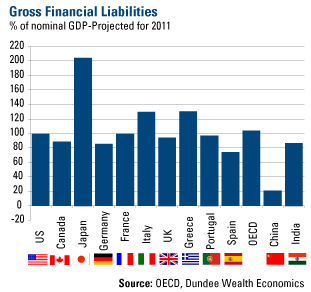 If the 2008 financial crisis was characterised by private debt being bailed out by public debt (ie borne by the long suffering taxpayer), then who will come to the rescue of sovereign debt? Which government(s) is going to foot the tab on another's profligacy? It seems another floor has just been built on the house of cards.
With this new set of economic machinations, the chart above points to next year’s sovereign debt estimates for the G7 and other key global economies. The U.S. debt in 2011 would be about equal to GDP (US$15 trillion) while the debt loads carried by Japan, Italy and Greece would exceed GDP.
There is a concern among investors that not all is right with the financial world and they don't fully understand it. They think central bankers might be debasing their currencies and so there is an interest developing in gold. If their personal wealth can be affected by the future inflation spawned by the trillions of dollars and euros created to finance economic rescue plans, then the potential implications for gold are profound.
What is currency debasement and how does one measure it? This may once have been the domain of a few old Germans, Latin Americans and Asians to think about. The recent ferocity in which it has struck Mittel Europa has un-nerved many who are slowly coming round to the view the Euro is heading inexorably towards Argentine peso status. It won't be just clattering pots and pans in the streets...the trade union molly-coddled Greeks can attest to something more vigourous.
Here’s one way to look at currency destruction. 10 years ago this week, US$1,000 bought nearly four ounces of gold and today US$1,000 won’t even get you a single ounce (today's spot price is US$1,215). Gold is money, so when you look at the gold-US dollar exchange rate, the dollar’s value has fallen by a startling 70%+ just in the past decade...and that's the global reserve currency!
To hold gold is not about getting rich, but a means to diversify assets and protect wealth.
Saturday, 8 May 2010
Acropolis now...the web of PIIGS debt exposed in technicolour
The following pentagram is from the New York Times. Crafted from the BIS (Bank of International Settlements) data, it shows the total debt load of the PIIGS (Portugal, Ireland, Italy, Greece and Spain) nations as at 31st December, 2009 spotlighting how much is owed:
1. between the PIIGS nations themselves and
2. from the PIIGS to the major trading European partners, France, Germany and the UK
Arrow widths are proportional to debt amounts.
The joint EU/IMF rescue package this week of euro 111 billion or US$145 billion (bn) to bail-out Greece has triggered a burning fuse which will have global ramifications. It will leave the much maligned 1990s Asia currency contagion in the dust. There is simply too much interlinked debt in the European financial system at alarming proportions of national GDPs, one wonders how they will ever be rolled-over, never mind paid off.

After Greece, like dominoes, the other PIIGs are about to topple.
It's a sobering thought. EU leadership has been virtually non-existent. The world got a glimpse of this when the Eyjafjallajökull volcano erupted in April and paralysed European airspace for days costing the airlines billions. The Greece situation has merely amplified this.
The value of fiat paper money is waning. We are still some distance from the devastation wrought by hyperinflation in 1920s Germany, 1990s Argentina and 2000s Zimbabwe. It will take magical healing powers for the European financial system to untangle itself and escape the dark forces of dislocation building up within this pentagram.
The watershed moment has finally arrived to fully recognise gold and silver are real alternatives to holding paper money as a store of value.
1. between the PIIGS nations themselves and
2. from the PIIGS to the major trading European partners, France, Germany and the UK
Arrow widths are proportional to debt amounts.
The joint EU/IMF rescue package this week of euro 111 billion or US$145 billion (bn) to bail-out Greece has triggered a burning fuse which will have global ramifications. It will leave the much maligned 1990s Asia currency contagion in the dust. There is simply too much interlinked debt in the European financial system at alarming proportions of national GDPs, one wonders how they will ever be rolled-over, never mind paid off.

After Greece, like dominoes, the other PIIGs are about to topple.

It's a sobering thought. EU leadership has been virtually non-existent. The world got a glimpse of this when the Eyjafjallajökull volcano erupted in April and paralysed European airspace for days costing the airlines billions. The Greece situation has merely amplified this.
The value of fiat paper money is waning. We are still some distance from the devastation wrought by hyperinflation in 1920s Germany, 1990s Argentina and 2000s Zimbabwe. It will take magical healing powers for the European financial system to untangle itself and escape the dark forces of dislocation building up within this pentagram.
The watershed moment has finally arrived to fully recognise gold and silver are real alternatives to holding paper money as a store of value.
Subscribe to:
Posts (Atom)

