Showing posts with label Gold. Show all posts

Friday, 5 August 2011

S&P 500 back to March 2009 lows...in gold terms...

On March 6th 2009, the United States Standard & Poors 500 (S&P 500) index made an intraday low of 666. Gold on that day was $965. Thus, the S&P 500 bought .69 ounces of gold.

Today, at the intraday high of gold and the low of the S&P 500, the index bought .73 ounces.

Therefore, in gold terms and/or in REAL terms as opposed to NOMINAL money terms, today’s action in the S&P 500 has propelled us basically back to the March ’09 low.

What this means is gold closing at US$1,648 today is not expensive / overvalued.

Given the choice to invest in a broad index fund or purchase gold bullion (government mint coins, private mint rounds, bars etc), albeit these do not pay interest and dividends, you can sleep peacefully without contending with all the financial markets' volatility and USA and Eurozone sovereign debt crisises.

Going forward, gold is in a bull market, it is a store of value, it's real money. The financial markets still are still rivetted with risk. I encourage you to research this and consider buying the physical stuff or a financial ETF (NYSE: GLD).

Sunday, 26 September 2010

A History of 50 Investment Bubbles

With the price of gold and silver scaling new heights recently, how does this performance compare against historical bubbles that formed and burst? Tulipmania in Holland during the 1600's and the South Sea bubble of 1720 spring to mind... the graphic below (Sharelynx.com) shows 50 historic bubbles from days gone by.

In this context, the chart shows that this current bull market in the precious metals is barely off the ground compared to other bubbles.

Double click on the image to enlarge...

Tuesday, 18 May 2010

What is currency debasement and why gold will be the next world currency?

If the 2008 financial crisis was characterised by private debt being bailed out by public debt (ie borne by the long suffering taxpayer), then who will come to the rescue of sovereign debt? Which government(s) is going to foot the tab on another's profligacy? It seems another floor has just been built on the house of cards.

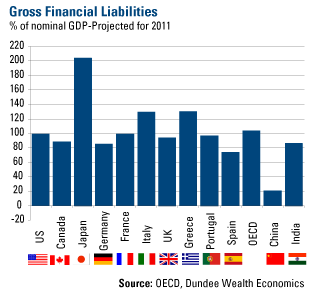
With this new set of economic machinations, the chart above points to next year’s sovereign debt estimates for the G7 and other key global economies. The U.S. debt in 2011 would be about equal to GDP (US$15 trillion) while the debt loads carried by Japan, Italy and Greece would exceed GDP.

There is a concern among investors that not all is right with the financial world and they don't fully understand it. They think central bankers might be debasing their currencies and so there is an interest developing in gold. If their personal wealth can be affected by the future inflation spawned by the trillions of dollars and euros created to finance economic rescue plans, then the potential implications for gold are profound.

What is currency debasement and how does one measure it? This may once have been the domain of a few old Germans, Latin Americans and Asians to think about. The recent ferocity in which it has struck Mittel Europa has un-nerved many who are slowly coming round to the view the Euro is heading inexorably towards Argentine peso status. It won't be just clattering pots and pans in the streets...the trade union molly-coddled Greeks can attest to something more vigourous.

Here’s one way to look at currency destruction. 10 years ago this week, US$1,000 bought nearly four ounces of gold and today US$1,000 won’t even get you a single ounce (today's spot price is US$1,215). Gold is money, so when you look at the gold-US dollar exchange rate, the dollar’s value has fallen by a startling 70%+ just in the past decade...and that's the global reserve currency!

To hold gold is not about getting rich, but a means to diversify assets and protect wealth.

Thursday, 8 October 2009

Gold price sets new record...but not in euro, rupee, yen yet

The gold price touched a new record high over US$1,045 today on the American commodity metals exchange (COMEX).

This was sparked off by news from the UK based Independent newspaper the Gulf Arab oil exporting nations were secretly planning with Russia, China, Japan and France to set crude oil pricing in a basket of currencies instead of the US$. This basket would include the euro, yen, yuan and gold. If the story is verified, this is a signal the US$ a worldwide reserve currency is on the brink of a permanent decline. China has already hinted in recent months to diversify away from buying US Treasuries.

This headline-grabbing gold rally must be viewed with caution. If one believes in purchasing- power-parity theory eg. the price of gold per ounce should be the same in all countries (after adjusting for exchange rates) otherwise, arbitrage will happen ie. a person buys the gold in the cheaper country and sells this at a higher price elsewhere. On this basis, the price of gold should have reached a record high too in the local currencies of other countries.

However, the charts below indicate this did not happen. Something is amiss. While gold is up in US$ and close to its highs in rupees (India is an active gold purchaser due to jewellry demand), prices are still about 10% down from their highs in both euro and yen currencies. This indicates the strength comes from a relatively weaker US$ instead of a spike in real demand. Further, it also suggests speculation in the COMEX futures markets (which trades in US$) is at very high levels and this excess can be pricked at anytime (witness crude oil's spectacular fall in summer of 2008 from record US$147 / barrel).

Gold's breakout will only prove sustainable and convincing if all these countries trigger new pricing highs in their respective currencies. That time is not far off...but it is not this week.