Showing posts with label us debt. Show all posts

Sunday, 19 February 2012

A graphic picture of debt relative to GDP for major world economies


World governments have borrowed massive amounts of money to live beyond their means. Above is a graphic showing the world's largest economies, how much debt they borrowed and the interest payment due relative to their GDP. The tab is piling up...

Bloomberg: World’s Biggest Economies Face $7.6 Trillion Bond Tab as Rally Seen Fading 

How the debt eventually piles up?
This is just an ordinary US$ 100 bill


US$ 10,000 can fit snugly into your trouser pockets...


Hmm...US$ 1 million needs a decent sized briefcase...


At US$ 100 million, one needs to stack these notes onto a pallet....


US$ 2 billion dollars...that's 20 pallets loaded onto a truck...

Now let's visualise how major countries debts are piled up compared to the size of national landmarks...

The number of red pallets represent government repayments due in 2012;  yellow equates to the outstanding debt after the 2012 repayments; the trucks represent the 2012 interest payments due on the total debt piles

Hat-tip to Demonocracy.info

India
India is rather poor if you look at individual income but because of its large population, skewed with younger demographics in which more than 50% are under age 25 and 65% under 35 ,  it is a significant economic power-house in the world.

It has racked up a debt of 74% of the economy in 2011, which is more than the 60% debt to economy ratio set by EU for economic stability standard.

China

The debt pile seems rather scary for China but the size of its economy and population is not to be underestimated. The debt only accounts for ~17.5% of the economy.

China has the world's second largest economy, overtaking Japan in 2011, it is still experiencing economic growth and has the biggest foreign exchange reserves in the world at US$ 3,200 billion.

The bigger the foreign exchange reserves, the more power the country has to influence the value of its own currency.

The greater a country's foreign reserves, the better position it is in to defend itself from speculative attacks on the domestic currency.

It is also accumulating gold bullion aggressively in 2011 to diversify its "paper" reserves.

Japan
Japanese debt stacked around the destroyed Fukushima Nuclear Power Plant. Japan could have built a wall of money to keep Fukushima safe from the Tsunami, with all the money they borrowed.

Fukushima Power Plant compared to the trucks is GIGANTIC.

Japan is a unique example. It holds a MASSIVE 228% debt to economy ratio. This is only possible because of loyalty of Japanese people to the Japanese government. Japan's people are the main buyers of Japanese government debt, and as long as they blindly buy the debt, and interest rates don't go up, they can practically run up the debt indefinitely. The issues start when everyone starts wondering how they will get the money back.

While historically having a good export surplus; Japan still has two "lost decades", where it has experienced no economic growth. This is mainly due to the large amounts of debt.

United States

USA is the nation with most debt by far in the history of human civilization.

USA's total debt, including personal debt, real estate (mortgage) debt, consumer debt, credit card debt and government debt totals a mega US$ 47,992bn, roughly 2,400 trucks full of money. That's the huge wall at the back in the graphic. Source: US Debt Clock

USA borrowed US$ 1,229 billion in 2011 - roughly 2.5x towers of cash in the background. USA runs a mega ~35% budget deficit, far above the 3% max limit set by EU for economic stability standard.

With industrialized world economies in crisis, USA faces little problem to finance its budget deficit in 2012 since world's money is currently flowing into USA in great numbers as investors try to find "safety" where to store their money, since Europe is not safe; neither are banks.

As long as USA has access to cheap credit due to scared investors willing to hand over their money in name of "safety", USA's interest payments will remain far below normal. Much depends on it retaining its AA+ credit rating and the US dollar's status as a world reserve currency.

Canada

Canada has a US$1,577 billion economy, while carrying a relatively insignificant trade deficit of US$ 9 billion.

In 2012 Canada must re-pay and/or re-finance a significant portion of its debt. It must refinance 42% of its debt, but since the country carries as AAA credit rating as of Jan. 2012 it faces little challenge to re-finance its debt.

Brazil
Brazil has in recent years become an Economic power-house and is now included in the G7 (Group of 7) nations meetings.

The economy is rated at US$ 2,517 billion.

With a 4.7% unemployment in 2011 and an export surplus it it is doing rather well.

United Kingdom
The UK has a large economy of US$2,480 billion but now holds debt in the size of ~75% of economy, which is more than the 60% max debt to economy ratio set by EU for economic stability standard.

As of Jan 2012, UK holds a AAA credit rating but has a staggering Gross External Debt of US$8,981 billion(not shown).

The private sector of UK (people, business', etc) are highly indebted, only surpassed by USA. High debt slows economic growth and it is reflected in the slow 0.9% growth of economy in 2011, which is much lower than the 4.2% inflation - meaning people of UK are becoming more poor as of 2011/2012.

France
The French are among the countries attacking PIIGS countries for their bad economic behavior, but are increasingly finding themselves in the same economic situation.

Their credit rating was downgraded from AAA to AA+ recently and hold a 83.5% (2011) debt to economy ratio, above the 60% set by EU for economic stability standard.

French banks are also among the financially weak banks that pose a danger to the French economy.

 Italy
Italy's economy is considered weak and too indebted for safe financial operation. Even its key commercial banks, including Unicredit, are a total mess.

It has a debt ratio of 118.1% (2010) to economy, far above the 60% limit set by EU for stability. Italy faces a GIANT re-payment / re-finance of US$ 428 billion of its debt in 2012, with strong fear that it will have problems finding lenders/investors that want to lend the weak country money.

Credit rating agencies say the outlook for Italy is negative, which means their credit rating will be down-graded in the future, as the debt takes serious toll on the economy and try struggle to pay back their debt.

This will further scare lenders / investors away and force the interest rates up - amount of trucks full of cash of tax-payer money sent to investors / banks / lenders.

Germany
Germany is considered the flag-ship of European economies.

Germany holds a ~80% debt ratio to economy, above the 60% limit standard set by EU for stability, while being mad at Greece and PIIGS for doing the same.

Germany faces a US$ 285 billion repayment/refinance of debt in 2012 but sees no problem of finding lenders, since Germany's economy looks great compared to the rest of the industrialized world.

Russia
The motherland is doing great...

Russia compared to its large economy holds barely any government debt - only 2.5% of economy (GDP).

Russia's Government benefits from large export surplus to pay for government's expenses.

The export surplus comes mainly from exporting natural resources, including natural gas and oil.

Sunday, 18 December 2011

China's 2011 holdings US Treasuries debt cut again in October

China trimmed its holdings of US Treasury debt by US$ 14.2 billion in October, driving its holdings to the lowest level this year.

This move to cut the US debt holdings indicated an attempt by the People's Bank of China (PBOC) to increase its cash holdings of dollars in order to shore up the value of the yuan.

The yuan has been faced with increasing downward pressure as investors sold the currency seeking a safe haven in the US dollar amid a grim outlook for the global economy.


China held a total of US$ 1,134 billion of US Treasury debt as of October 2011. According to the US Treasury Department, China accounted for approximately 24% of total foreign holdings of US debt. Despite this latest cut, China remains the largest foreign holder of US treasuries.

Analysts advocate China should continue to accelerate the diversification of its US$ 3.2 trillion foreign-exchange reserves, amid growing global financial uncertainty. Currently, about one-third of China's foreign-exchange reserves is invested in US Treasury bonds.

The PBOC has been reported it's planning to create a fund worth US$ 300 billion to invest the country's foreign-exchange reserves in the US and European markets. The fund will reportedly seek to invest in real assets and company shares, rather than government securities.

Gao Xiqing, vice-chairman of China Investment Corp, the country's sovereign wealth fund, said recently that the fund is actively looking for investment opportunities in infrastructure projects in countries including Britain, the US, and Brazil.

Saturday, 19 November 2011

Interactive Graphic on Worldwide Bank Debt - Who owes what to whom?


Click on image above to enlarge view

Click and visit this interactive link below to find out who owes what to whom...let's annex some respite from the relentless daily drumbeats of a worldwide financial edifice on the verge of collapse...winter maybe on its way but it doesn't mean we cannot have some light-hearted fun...
Source BBC News: Debt Web - Who owes what to whom?

These insightful graphics from the British Broadcasting Corporation valiantly attempt to peel away the layers of national banking debt each of the major world economies is owed from another.

I want to believe Santa Claus has a distant cousin somewhere in Harbin...

Notes on the data: 
The Bank for International Settlements data, represented by the proportional arrows, shows what banks in one country are owed by debtors - both government and private - in another country. It does not include non-bank debts. Only key eurozone debtors and their top creditors are shown. Although China is known to hold European debt, no comprehensive figures are available. 

GDP figures are the latest complete 2010 figures from the IMF. The percentage of gross government debt to GDP is also the latest IMF calculation. 

Overall foreign (or gross external) debt is taken from the latest 2011 World Bank/IMF figures and includes all debt owed overseas, including that owed by governments, monetary authorities, banks and companies. 

Gross foreign debt per person is calculated using the latest medium variant population figures from the UN Population Division.

Saturday, 17 September 2011

China's WEF warning on its US Treasury sovereign debt holdings...orderly liquidation...

China has explicitly warned the debt markets...

A key rate setter for China's central bank let slip, or was it a slip, that Beijing aims to run down its portfolio of United States debt as soon as safely practicable.

"The incremental parts of our of our foreign reserve holdings should be invested in physical assets," said Li Daokui at the World Economic Forum in the very rainy city of Dalian, formerly Port Arthur from Russian colonial days. Mr Li, one of three outside academics on China's Monetary Policy Committee, described the debt deals on Capitol Hill as "just trying to by time", saying it will not be enough to stop America's "debt dynamic" turning dangerous.

"We would like to buy stakes in Boeing, Intel, and Apple, and maybe we should invest in these types of companies in a proactive way."

"Once the US Treasury market stabilizes we can liquidate more of our holdings of Treasuries," he said.

It appears this is the first time a top adviser to China's central bank has uttered the word "liquidate". Until now the policy has been to diversify slowly by investing the fresh US$200bn, on average, accumulated each quarter into other currencies and assets, mainly AAA euro debt from Germany, France and the hard core.

It is not clear how much US debt is held by SAFE (State Administration of Foreign Exchange), the Chinese central bank's forex arm. The figure is thought to be over US$2.2 trillion. What's clear is a large vexed seller is agog to let go.

The relevant ETF (NYSE: TBT) to capture this directional move, as confidence in US Treasuries slowly erodes, is the ProShares UltraShort 20+ Year Treasury; it seeks daily investment results that correspond to twice (200%) the inverse (opposite) of the daily performance of the Barclays Capital 20+ Year U.S. Treasury Bond Index (the Index).

Saturday, 6 August 2011

Standard & Poors Cuts USA credit rating from AAA to AA+...Federal Reserve on the defensive...next steps?

It was the biggest open secret in Washington DC the failure to satisfactorily tackle the USA debt ceiling debate was going to trigger an urgent ratings review which had been signaled by S&P earlier this year.

It's now happened. S&P announced the downgrade on Friday night around 8.30pm EST, Saturday morning 8.30am Asia. It was a monumental moment in the history of America.

The Federal Reserve had bet the farm QE2 last August and it has lost. The worst move here would be to double-down on QE3, because if it failed to rouse global markets in a sustained fashion, then the Fed's remaining credibility and "magic" would vanish in a puff of smoke.

Would you pull out your super bazooka American Express card now to patch over the last 3 years juggling act using the Mastercard to pay off the Visa debt balance?

The perception has now changed. Interest rates around the world are going to edge up over the next 6 months as the reference price of "risk-free" rates long revered in US Treasury bills are redefined. Should central banks decide not to move interest rates up in order to manage their fragile economies, then expect a degree of foreign exchange rate volatilty.

The impact for the next 6 months will be:
  • The wealth effect will start to diminish as asset values become more "costly" to own and service. Will corporates and consumers continue to "pay more" and chase assets?
  • Stock markets will have to rapidly adjust for and reflect the extra interest expenses within companies as debt (re)financing becomes more expensive. These are headwinds for those large leveraged companies and small businesses reliant on their bankers.
  • Bonds prices trend downwards as investors rethink pricing in the context of a rising interest rate environment
What are the range of options and next steps available to ordinary consumers:
  • Pare down stock market portfolios to eliminate as much market risk as possible, so long as financial markets remain vulnerable, and politicians lack real impetus to resolve sovereign debt concerns. Stay with boring stable companies eg utilities that generate dependable cashflows.
  • Retain a strong cash component in portfolios to take advantage of potential fire-sale opportunities. Financial markets can over-react emotioally to the downside eg Oct. 2008 & Mar. 2009 as fundamentals get tossed out of the window in panicked dashes to the exits.
  • Property investors (the above-water, positive-equity universe) should consider locking in their capital gains and take a breather.
  • Assess the alternative of owning precious metals...gold and silver. Historically these have provided a store of value and risk/uncertainty hedge in volatile financial climates.
The US dollar's reserve status held since 1945 is waning. Over the last four weeks, the world has watched aghast as the internet era threw open the incessant bickering within the highest echelons of American government. The mantle of trust and faith in the creditworthiness of the USA, gingerly built up throughout the 20th century, is eroding. Asia is well positioned, but not guaranteed, to assume the economic vitality that has served America so well in the past.

QE3 will not be a panacea...more like Ben Bernanke riding to the rescue on a lame horse. Stay nimble and let the game come to you.

Thursday, 21 April 2011

Standard & Poors Cuts USA Sovereign Credit Rating to "Negative" from "Stable"

The US ratings agencies, long discredited for kow-towing to the major Wall Street investment houses, as they led a race to the bottom in terms of assigning ratings to sophisticated and complex instruments they themselves were not able to fully understand, finally peered over the fiscal precipice on Monday with Standard & Poors opening the first salvo to admonish the US sovereign credit rating. It cut its long-term outlook on the US to "negative" from "stable." The revision sparked fears that Uncle Sam could soon surrender his coveted "AAA" rating, the cornerstone of "reserve currency" status.

I've always seen these firms as lagging indicators to the machinations in the real economy. Look at what happened in the Eurozone with Greece, Ireland and Portugal. They were late...as usual...in recognising the gargantuan sovereign fiscal risks. Maybe they don't see it as part of their remit anymore to stand up to and ruffle governments' feathers before fiscal road accidents happen. It used to be said the role of the Federal Reserve was to take away the punch bowl just as the party got swinging...with the independent ratings agencies jousting alongside in tandem. However, the pressure within these agencies to search for new sources of income compromised their high ethical standards in the quarterly earnings pressure-cooker that is Wall Street.

For most of 2011, long-term bond yields have been in a trading range between 4.375% and 4.65%. Despite the upward trajectory of QE2 money printing, an endless stream of Treasury bonds issuance and foreign buyers starting to make noises about US fiscal irresponsibilty (Brazil, Russia and China) and the Government's ability to repay, yields have remained stubbornly low.

But interest rates will have to go higher soon...the Treasury has to offer attractive yields to appeal to these overseas buyers to buy ever higher volumes. In February, PIMCO, led by bond king Bill Gross, a conservative bond stalwart, announced its exit from the US treasury market completely. That's akin to Burger King declaring they no longer will use beef in their burgers.

The opportunity to short the treasury bond market is not far off, with yields near the lowest points and pricing near the top of their trading ranges. QE2 ends on 30th June and will open up uncertainty as the market addicts develope cold turkey. Where else can one find the grease to ramp up the markets? A lucrative ETF, ProShares UltraShort 20+ Year Treasury (symbol NYSE: TBT) is a good proxy to brace for a decline in treasury prices, gaining 2% for each 1% fall in price.

Tuesday, 18 May 2010

What is currency debasement and why gold will be the next world currency?

If the 2008 financial crisis was characterised by private debt being bailed out by public debt (ie borne by the long suffering taxpayer), then who will come to the rescue of sovereign debt? Which government(s) is going to foot the tab on another's profligacy? It seems another floor has just been built on the house of cards.

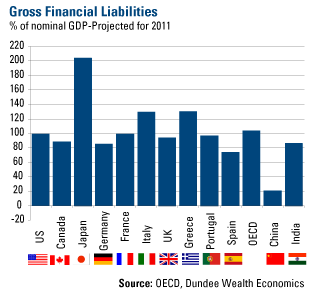
With this new set of economic machinations, the chart above points to next year’s sovereign debt estimates for the G7 and other key global economies. The U.S. debt in 2011 would be about equal to GDP (US$15 trillion) while the debt loads carried by Japan, Italy and Greece would exceed GDP.

There is a concern among investors that not all is right with the financial world and they don't fully understand it. They think central bankers might be debasing their currencies and so there is an interest developing in gold. If their personal wealth can be affected by the future inflation spawned by the trillions of dollars and euros created to finance economic rescue plans, then the potential implications for gold are profound.

What is currency debasement and how does one measure it? This may once have been the domain of a few old Germans, Latin Americans and Asians to think about. The recent ferocity in which it has struck Mittel Europa has un-nerved many who are slowly coming round to the view the Euro is heading inexorably towards Argentine peso status. It won't be just clattering pots and pans in the streets...the trade union molly-coddled Greeks can attest to something more vigourous.

Here’s one way to look at currency destruction. 10 years ago this week, US$1,000 bought nearly four ounces of gold and today US$1,000 won’t even get you a single ounce (today's spot price is US$1,215). Gold is money, so when you look at the gold-US dollar exchange rate, the dollar’s value has fallen by a startling 70%+ just in the past decade...and that's the global reserve currency!

To hold gold is not about getting rich, but a means to diversify assets and protect wealth.

Saturday, 17 April 2010

In with Mars and out with the moon - Obama's new frontier

On Thursday, 15th April, President Obama announced at Cape Canaveral the scrapping of the moon programme which he had inherited from George Bush. Understandly this drew consternation from the Apollo astronauts who flew the 1960s and 1970s moon missions as a sign of American demise.

Instead Obama delivered a US$6 billion boost in NASA's budget, then offset the cancellation of a mission that would once again send men to the moon by announcing a new program to land astronauts on Mars... and drop in on an asteroid as well.

Over the course of my days on this remarkable planet of ours, I have had the opportunity to get to know all manner of personality types. One of the most troubled have been the serial spenders... deluded individuals that simply can't help but buy all that their hearts desire, no matter how much pain results from their debt-financed spending. That describes today's political class.

Unless and until you start hearing the president making speeches about not going to Mars, followed by wishing legions of negative-equity houseowners who bought over their heads and government employees the best of luck as they start to toss away their their credit cards and enter the private sector, the only conclusion to be drawn is that a space ship isn't the only thing headed for outer space, but government debt as well.

This spending is unsustainable...


Click below for Obama's personality trait as analysed by a world personality expert:
Dr Sam Vaknin, narcissism, Obama and the fate of the world economy