Showing posts with label euro. Show all posts

Sunday, 2 September 2012

A history of currency and monetary exchange rate systems


To view and make the image bigger, click here
Do you get confused by currencies? Why and how do they move? What is the role of Governments? Knowing a brief history of currency exchange rate systems can help you understand today's three vexing questions which are, will:
1) the US dollar retain it's status as the world's reserve currency?
2) the Euro collapse within the next 5 years?
3) the China remninbi (yuan) be a potential challenger to replace the US dollar in the future?

Take the US dollar for instance... each 10, 20, 50 and 100 dollar note assures you, the cherished owner, the right to redeem it for…5, 10, 20, 50 and 100 dollars respectively. It's purchasing power today should not be confused with its intrinsic value (the amount of collateral it's backed by).

Is this just a simple “I-give-it-to-you-so-that-you-can-give-it-back-to-me” manoeuvre or are there other odious forces involved you are not aware of?

Let's take a look at this graphic which does a quick roundtrip of this quirk and recounts the evolution of currency systems from 1821 to the present day.

As it turns out this history is far more exciting than is usually let on (think political thriller as opposed to economic textbook!). For a rivetting exposé, I recently read and recommend a book by James Rickards (an American economist and 35+ years Wall Street investment banker), author of the New York times bestseller published in 2011 Currency Wars.

 Infographic: hat tips to greshams-law.com and goldmoney.com  

Saturday, 19 November 2011

Interactive Graphic on Worldwide Bank Debt - Who owes what to whom?


Click on image above to enlarge view

Click and visit this interactive link below to find out who owes what to whom...let's annex some respite from the relentless daily drumbeats of a worldwide financial edifice on the verge of collapse...winter maybe on its way but it doesn't mean we cannot have some light-hearted fun...
Source BBC News: Debt Web - Who owes what to whom?

These insightful graphics from the British Broadcasting Corporation valiantly attempt to peel away the layers of national banking debt each of the major world economies is owed from another.

I want to believe Santa Claus has a distant cousin somewhere in Harbin...

Notes on the data: 
The Bank for International Settlements data, represented by the proportional arrows, shows what banks in one country are owed by debtors - both government and private - in another country. It does not include non-bank debts. Only key eurozone debtors and their top creditors are shown. Although China is known to hold European debt, no comprehensive figures are available. 

GDP figures are the latest complete 2010 figures from the IMF. The percentage of gross government debt to GDP is also the latest IMF calculation. 

Overall foreign (or gross external) debt is taken from the latest 2011 World Bank/IMF figures and includes all debt owed overseas, including that owed by governments, monetary authorities, banks and companies. 

Gross foreign debt per person is calculated using the latest medium variant population figures from the UN Population Division.

Thursday, 10 November 2011

Eurozone countries 10 year bond yield history - the great unravelling


The great unraveling of the Eurozone has taken an ominous turn...bond yields have shot up in Italy as investors perceive the sovereign risk to have deteriorated. Greece, Portugal and Ireland have already floundered on the credit rocks.

Yesterday, Italy's yields acrossed the 7% Rubicon. A 7% yield is widely deemed as unsustainable and has previously led to bailouts and talk of default in smaller euro zone economies such as Portugal, Ireland and Greece. The crisis will not end simply with Berlusconi's excruciatingly slow demise. If the thinking now is that Italy also needs a bail out, there's a problem. Italy has two trillion euros of debt. That’s greater than the total amount of debt owned by Greece, Ireland, Portugal and Spain combined.

When the Euro was launched in 1999 there was much fanfare over the convergence of interest rates as sovereign risk appeared to equalise with markets not differentiating between economic fundamentals in each Eurozone nation. All started to unravel in 2008.

And, just by looking at the chart, you can tell that there's no way this implosion can be put back the way it was. If the euro is going to weaken, then the best way to play it is to buy the ProShares UltraShort Euro ETF (NYSE:EUO). Every 1% decline in the euro will move the ETF up by 2%.

Wednesday, 10 August 2011

Real Madrid bankers, Bankia, pledge Cristiano Ronaldo as collateral for more ECB funds...Moody's rate loan AAA

Bankia, banker to the world famous Spanish soccer Real Madrid, is really up against the wall amidst the current Eurozone debt crisis.

...very creatively, they have pledged as collateral in return for more funds from the European Central Bank (ECB), the club's loan on the Cristiano Ronaldo transfer.

The 2009 deal made Ronaldo's transfer from Manchester United to Real the most expensive footballer in history. He is one of their "galaticos" - star players. The loan has been rated AAA by Moody's.

Ronaldo now achieves the distinction of having a credit rating higher than the United States government, which was downgraded from AAA to AA+ last Friday.

Should both Bankia and Real Madrid go bust, the ECB would own Ronaldo.

Let's also hope for Bankia's sake, Cristiano doesn't suffer any serious playing injuries...like breaking his toe anytime soon...a subsequent "negative outlook with risk of downgrade" attached to the loan's credit rating would not be in the world's soccer...and economic interest.

Spanish bank fields Ronaldo as collateral - Daily Telegraph

Friday, 5 August 2011

S&P 500 back to March 2009 lows...in gold terms...

On March 6th 2009, the United States Standard & Poors 500 (S&P 500) index made an intraday low of 666. Gold on that day was $965. Thus, the S&P 500 bought .69 ounces of gold.

Today, at the intraday high of gold and the low of the S&P 500, the index bought .73 ounces.

Therefore, in gold terms and/or in REAL terms as opposed to NOMINAL money terms, today’s action in the S&P 500 has propelled us basically back to the March ’09 low.

What this means is gold closing at US$1,648 today is not expensive / overvalued.

Given the choice to invest in a broad index fund or purchase gold bullion (government mint coins, private mint rounds, bars etc), albeit these do not pay interest and dividends, you can sleep peacefully without contending with all the financial markets' volatility and USA and Eurozone sovereign debt crisises.

Going forward, gold is in a bull market, it is a store of value, it's real money. The financial markets still are still rivetted with risk. I encourage you to research this and consider buying the physical stuff or a financial ETF (NYSE: GLD).

Sunday, 15 May 2011

A new Eurozone stress test... Denmark shuts its borders to immigration...

On 11 May, Denmark shocked the European Union (EU) by announcing it will install permanent stations along its frontiers to curb crime and illegal immigration. Control booths will be erected at crossings to Germany and Sweden and in harbors and airports.

This contravenes the spirit of the 1985 "Schengen Agreement" — a free-travel system that has removed compulsory passport controls between many internal borders in Europe. The Schengen Area currently consists of 25 states, all but 3 of which are members of the European Union; the non-EU members being Iceland, Norway and Switzerland.

The system has been under pressure recently with the EU Commission considering reintroducing national border controls in the face of a flood of North African immigrants. The agreement in Denmark was made to meet demands from the government's nationalistic ally, the Danish People's Party, and is expected to be approved by Parliament.

With the Arab Spring in which conflagrations blew up in Algeria, Libya and Egypt, Mediterranean border nations like Greece, Italy, Spain and Malta have also complained that the 27-nation EU has dumped its immigration issues and the costs of dealing with illegal immigrants on their backs.

Coupled with recent economic fissures appearing inside the EU and aversion by some states to come to the rescue of fellow members, the bailouts of Greece, Ireland and Portugal have already dealt a crushing blow to the euro. Spain's fate looks sealed too. With the Denmark butterfly now flapping its wings, this could be a harbinger of a wider European fragility.

Nationalism looks to be increasingly asserting itself on both the ecoonomic and social fronts...the liberal fabric of Europe is be about to be sorely tested...

Saturday, 22 May 2010

China's devaluation dilemma: where next with the yuan, dollar and the euro?

The yuan is currently pegged to the US dollar in order to keep Chinese goods comparatively cheap in the key North American markets. As long as the US dollar is weak, the Chinese yuan is weak and therefore competitive in European markets. While complaints abound from the US about this "unfair" trade advantage, is it possible China has been blind-sided by the recent euro woes?

The US$-euro exchange rate is also a pillar to global trade. As the euro falls, countries are also under pressure to weaken their currencies. Specifically, China is under pressure to weaken its currency because Europe is the largest consumer of Chinese goods. In order to remain competitive, Chinese companies must reduce their profit margins or hope to make up reduced profits by increases in volume.

To weaken one's currency, one has to sell it and buy another currency. If you're China, would you rather sell the yuan to buy the euro, yen, or U.S. dollar? In this trio, the US dollar is king because it's the least worst scenario being the global reserve currency.

The Chinese government is now confronted with a policy dilemma because it has painted itself into a corner. Which exchange rate should it "manage" for the long term benefit of its export industries? It can either target the US$-yuan or the euro-yuan. It cannot aim for both as it has no influence over the US$-euro rate. As this chapter unfolds, distant images of how another major economic power blew up in the late 1980s with failed exchange rate targetting, from which it has never recovered, loom ever larger: Japan. This lack of control worries Chinese policymakers. This could be one reason why Chinese entrepreneurs have recently voiced their increasing concerns over their own government's US$-yuan policy. There are now bigger and wider issues at stake because entrepreneurs are not willing to invest in a climate of uncertainty.

Every country desires a weaker currency so it can export more goods. However, the only way to weaken one's currency is to sometimes make bad investments. Such economics make sense to a central banker: more exported goods mean more jobs, social cohesion and a higher GDP. So why would you fundamentally weaken your entire nation for one good year of exports? Imagine breaking all the windows in your city so that you will experience a building boom.

If market forces to allow the exchange rate to find their comfort levels are not the answer for China's zest for "control", then an alternative outlet needs to be created to protect the general Chinese investor community from the future vagaries of their export sectors. A safety valve that can stand the test of time. Precious metals are one such avenue.

Tuesday, 18 May 2010

What is currency debasement and why gold will be the next world currency?

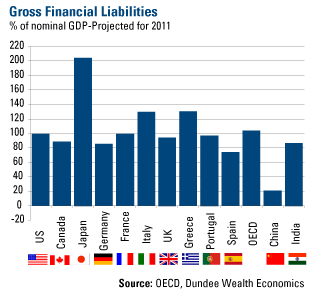
If the 2008 financial crisis was characterised by private debt being bailed out by public debt (ie borne by the long suffering taxpayer), then who will come to the rescue of sovereign debt? Which government(s) is going to foot the tab on another's profligacy? It seems another floor has just been built on the house of cards.

With this new set of economic machinations, the chart above points to next year’s sovereign debt estimates for the G7 and other key global economies. The U.S. debt in 2011 would be about equal to GDP (US$15 trillion) while the debt loads carried by Japan, Italy and Greece would exceed GDP.

There is a concern among investors that not all is right with the financial world and they don't fully understand it. They think central bankers might be debasing their currencies and so there is an interest developing in gold. If their personal wealth can be affected by the future inflation spawned by the trillions of dollars and euros created to finance economic rescue plans, then the potential implications for gold are profound.

What is currency debasement and how does one measure it? This may once have been the domain of a few old Germans, Latin Americans and Asians to think about. The recent ferocity in which it has struck Mittel Europa has un-nerved many who are slowly coming round to the view the Euro is heading inexorably towards Argentine peso status. It won't be just clattering pots and pans in the streets...the trade union molly-coddled Greeks can attest to something more vigourous.

Here’s one way to look at currency destruction. 10 years ago this week, US$1,000 bought nearly four ounces of gold and today US$1,000 won’t even get you a single ounce (today's spot price is US$1,215). Gold is money, so when you look at the gold-US dollar exchange rate, the dollar’s value has fallen by a startling 70%+ just in the past decade...and that's the global reserve currency!

To hold gold is not about getting rich, but a means to diversify assets and protect wealth.