Tuesday, 18 May 2010

What is currency debasement and why gold will be the next world currency?

If the 2008 financial crisis was characterised by private debt being bailed out by public debt (ie borne by the long suffering taxpayer), then who will come to the rescue of sovereign debt? Which government(s) is going to foot the tab on another's profligacy? It seems another floor has just been built on the house of cards.

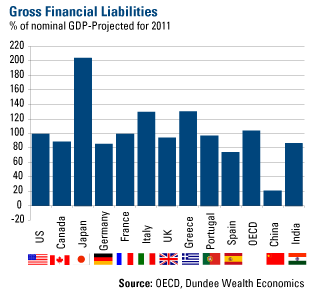
With this new set of economic machinations, the chart above points to next year’s sovereign debt estimates for the G7 and other key global economies. The U.S. debt in 2011 would be about equal to GDP (US$15 trillion) while the debt loads carried by Japan, Italy and Greece would exceed GDP.

There is a concern among investors that not all is right with the financial world and they don't fully understand it. They think central bankers might be debasing their currencies and so there is an interest developing in gold. If their personal wealth can be affected by the future inflation spawned by the trillions of dollars and euros created to finance economic rescue plans, then the potential implications for gold are profound.

What is currency debasement and how does one measure it? This may once have been the domain of a few old Germans, Latin Americans and Asians to think about. The recent ferocity in which it has struck Mittel Europa has un-nerved many who are slowly coming round to the view the Euro is heading inexorably towards Argentine peso status. It won't be just clattering pots and pans in the streets...the trade union molly-coddled Greeks can attest to something more vigourous.

Here’s one way to look at currency destruction. 10 years ago this week, US$1,000 bought nearly four ounces of gold and today US$1,000 won’t even get you a single ounce (today's spot price is US$1,215). Gold is money, so when you look at the gold-US dollar exchange rate, the dollar’s value has fallen by a startling 70%+ just in the past decade...and that's the global reserve currency!

To hold gold is not about getting rich, but a means to diversify assets and protect wealth.

Saturday, 8 May 2010

Acropolis now...the web of PIIGS debt exposed in technicolour

The following pentagram is from the New York Times. Crafted from the BIS (Bank of International Settlements) data, it shows the total debt load of the PIIGS (Portugal, Ireland, Italy, Greece and Spain) nations as at 31st December, 2009 spotlighting how much is owed:
1. between the PIIGS nations themselves and
2. from the PIIGS to the major trading European partners, France, Germany and the UK
Arrow widths are proportional to debt amounts.

The joint EU/IMF rescue package this week of euro 111 billion or US$145 billion (bn) to bail-out Greece has triggered a burning fuse which will have global ramifications. It will leave the much maligned 1990s Asia currency contagion in the dust. There is simply too much interlinked debt in the European financial system at alarming proportions of national GDPs, one wonders how they will ever be rolled-over, never mind paid off.


After Greece, like dominoes, the other PIIGs are about to topple.

It's a sobering thought. EU leadership has been virtually non-existent. The world got a glimpse of this when the Eyjafjallajökull volcano erupted in April and paralysed European airspace for days costing the airlines billions. The Greece situation has merely amplified this.

The value of fiat paper money is waning. We are still some distance from the devastation wrought by hyperinflation in 1920s Germany, 1990s Argentina and 2000s Zimbabwe. It will take magical healing powers for the European financial system to untangle itself and escape the dark forces of dislocation building up within this pentagram.

The watershed moment has finally arrived to fully recognise gold and silver are real alternatives to holding paper money as a store of value.

Thursday, 6 May 2010

Today the UK is at a crossroads. A general election with a vital decision to make and action urgently required...

In the tightest United Kingdom general election since 1974, the three main political parties are slugging it out to carve out a mandate to govern this island nation of circa 62 million, the 6th biggest economy in the world.

Speaking on Wednesday at Bradford University, the last day of campaigning, the Prime Minister, Gordon Brown said: "I know there are people who say, or hope, the election is already over. But I tell you that tomorrow is the time for the thousands of people to speak for themselves.

"Tomorrow doesn't belong to the press, to the commentators, to the insiders, to the vested interests or even to the political parties. Tomorrow your voice shall be heard and your vote will determine the direction of this country."

The right to vote in an open and transparent manner is commonly taken for granted in the western hemisphere. In Asia today, with perhaps India, Indonesia and the Philippines excepted, this is still very much a work-in-progress. We should genuflect on the millions of people who aspired and struggled to achieve this vision and did not live to realise their dreams.

During this momentary interlude in the daily heartbeat of a nation, the attention on the economy will rightfully and respectfully take a back seat while the heeled populace makes a beeline to the ballet box and cast a life influencing decision. Today nobody, including the Prime Minister, need be “primus inter pares” (first amongst equals). Amen to that…

Wednesday, 5 May 2010

Australia's new 40% mining super profits tax...the "Greater China tariff "

On Tuesday, the Australian government levied a 40% Resource Super Profits Tax on its mining industry to take effect from July 2012. The company tax rate would be cut from 30 percent to 29 percent in July 2013 and to 28 percent a year later.

In one stroke, the cost of doing business shot up overnight. The Australian mining sector accounted for $94 billion in exports during 2009, 38% of the total.

Multinationals like Rio Tinto and BHP Billiton were left scrambling in their wake as Australia is a vital cog in their global mining operations. Resource mining is a capital intensive industry and long term planning is essential, sometimes with payback taking many years.

Perversely, is this otherwise a Great China Tariff, a tax to soak the Chinese? The resource sector comprises 9% of Australia's economy. Australia exports 80% of its resources. Who is the biggest buyer of those resources? China. The Chinese bought US$42.4 billion of resources from Australia in 2009.

China is scouring the world for oil, natural gas, copper, coal, and iron ore supplies. It has a desperate need for the raw materials ... and lots of money to toss around in order to get it. Plus…China doesn't just buy products from Australia, it buys mining companies too (US$$20 billion worth in the last 18 months or so).

The proposed Australian super-profit tax reinforces the lesson China learned in 2005 and 2006: the resources aren't yours unless they are in your house. Instead of sending more money on taxes to foreign governments, China will spend that money in its domestic mining and energy infrastructure. Right now, China has no choice but to "pay up" for Australian resources. It has to have them to continue building. But stories like this are huge drivers for China's domestic exploration programs...

China can't replace Australian supplies of iron ore, tin, and oil with domestic deposits tomorrow... but the country does have some excellent prospects.

Saturday, 17 April 2010

In with Mars and out with the moon - Obama's new frontier

On Thursday, 15th April, President Obama announced at Cape Canaveral the scrapping of the moon programme which he had inherited from George Bush. Understandly this drew consternation from the Apollo astronauts who flew the 1960s and 1970s moon missions as a sign of American demise.

Instead Obama delivered a US$6 billion boost in NASA's budget, then offset the cancellation of a mission that would once again send men to the moon by announcing a new program to land astronauts on Mars... and drop in on an asteroid as well.

Over the course of my days on this remarkable planet of ours, I have had the opportunity to get to know all manner of personality types. One of the most troubled have been the serial spenders... deluded individuals that simply can't help but buy all that their hearts desire, no matter how much pain results from their debt-financed spending. That describes today's political class.

Unless and until you start hearing the president making speeches about not going to Mars, followed by wishing legions of negative-equity houseowners who bought over their heads and government employees the best of luck as they start to toss away their their credit cards and enter the private sector, the only conclusion to be drawn is that a space ship isn't the only thing headed for outer space, but government debt as well.

This spending is unsustainable...


Click below for Obama's personality trait as analysed by a world personality expert:
Dr Sam Vaknin, narcissism, Obama and the fate of the world economy